Like Luis, many people with risk factors don’t know they have MASH.

Real mash
patient stories
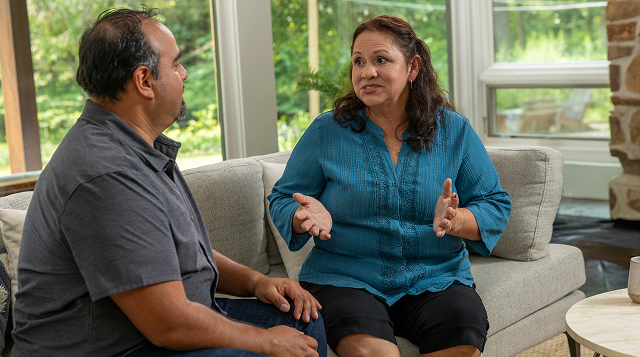
People with MASH share what it's like to live with this disease, and what changed when they decided to get answers and start to take control.

You're not alone and you can start to take control
Hearing from others with this disease can help you better understand it, so you can ask the right questions and feel confident taking action sooner rather than later.
LUISLuis first experienced metabolic issues in college that led to weight gain and fatigue. Years later, he was diagnosed with MASH. With unwavering support from his family, he began making consistent lifestyle changes, one step at a time. This family-backed journey fueled his drive to share openly, reminding others that it’s never too early to prioritize one's health.
Transcript
Hey, I'm Luis. I've been living with MASH for 11 years now. It kind of started during college. And during those years, I was an engineering student. Not a lot of time to really exercise. So, when I finished college, I ended up gaining 40 pounds. I was stressed out all the time. I'm a perfectionist. I always want to be the best at what I do. So, I just have this constant pressure on myself. I started a job, and I had an hour commute. I was just constantly tired, and it was getting worse. I was seeing my primary care physician for a while, and she was tracking my blood work, primarily, and was trying to encourage me to make lifestyle changes because at that time she felt like, you know, that was my best plan. So, she sent me to see a hepatologist and they first ran more blood work. It took a while to get that initial appointment and then later an ultrasound and then after that another follow-up. I was sent to get a FibroScan®. I was diagnosed with metabolic dysfunction-associated steatohepatitis. It was just disbelief, you know. It felt like a dream in some ways, because I had never been in that position before. So, it was, it was difficult for me to accept that. For me, the kids were always my motivation to get better because, you know, I wanted to be there for them when they have their graduations, when they get married. I always felt supportive of my family throughout that process to encourage me to get better. My mom and I have a very special connection. She's always been so supportive. Even in college, when I would gain weight, I would want to get into shape again. She was always preparing meals for me, you know, eating healthier. So, I've always felt this unconditional love from her, always encouraging me to, to make better choices and also accepting that I'm a human, that I am not perfect. I wasn't aware this condition was more prevalent in the Hispanic community. We’re more reserved about sharing this knowledge, and I'm always hearing through the grapevine about somebody else in my family that had something else happen to them. Some advice that I would give others living with MASH is really to start where you are, not where you're trying to be. For me, it was not really, you know, trying to be that athlete, you know, and getting the perfect diet and figuring, you know, the best way to reduce fat in my liver. It was just making those small changes. I think that's important for all of us to feel comfortable sharing those stories because the more we open up, the more we can learn from each other and we can prevent more people from, from getting this disease.
|
MIMIFor years, Mimi put teaching and motherhood ahead of her own health. After being diagnosed with MASH in 2017, she was determined to take control by staying hydrated, exercising regularly, eating healthier, and relying on her support network. These steps gave her strength and, inspired by the memory of her late son, a voice to guide others. Today, she shares her story to motivate others in the Hispanic community to prioritize their health. |
WESAfter 15 years as a paramedic, Wes was diagnosed with MASH, prompting a major shift in his life. With support from his family and care team, he embraced lifestyle changes and found strength in everyday life. Now, he shares his journey to help others feel seen, informed, and motivated.
Transcript
I’m Wes, and… I’ve had MASH for almost three years. I devoted my career to being a paramedic. As a paramedic, it was more about being there for people when they’re having their worst day. I did that for like 15 years, and then I changed my mind, and I went into data analytics. One of the things that I like about data is the ability to take what just looks like a bunch of numbers, which maybe don’t make sense, and turn them into something that kind of tells the story. I was having a lot of stomach discomfort. So, I had talked to my doctor about it, and we started doing a lot testing. It took months of different tests, scans, blood tests, physical exams, meeting with the gastroenterologist. So, my doctor diagnosed me with MASH, which is metabolic dysfunction–associated steatohepatitis. And he kind of explained each of the different, you know, phases. And it was really hard to hear. He explained that I had previously had fatty liver, that my liver biopsy showed that I have fibrosis. I had the risk factors of having a high body mass index, and like, genetics, like, having just a predisposition to fatty liver disease. How am I going to change my life? Because I’m going to have to change it. And so, I thought about, like, my kids, I have five kids, so, they really need me around, and I want to be around. My wife’s amazing. She’s very caring, she’s very kind. And my wife will tell you this, I’m—I’m very stubborn, and I’m also very determined. As a way to kind of help me cope, I came up with—I have, like, spreadsheets of every lab value. It helped me being able to, like, look at the numbers in the labs and see, like, visually, like, what does the data tell me, what’s my story. But the biggest thing was really putting in more walking, getting some more activity in the middle of the day. MASH impacts my life mostly by just the amount of energy that I’m going to have. And there’s the diet portion of it. Changing your diet does matter. My physician’s assistant, her and I, through the process of trying to figure out what was going on with me, we both kind of journeyed through that together. And that has been a great part of my care is being able to have someone who is right there with me, help me to be more comfortable, and talk through what I’m experiencing. I came across support groups. They were a big help in finding not only information but also like people who are currently going through what I’m going through at the same time. Some advice I would give others living with MASH would be finding a really good support network of family members, friends, but also including your physician. I feel like I’m making a difference, even if it’s a small thing. Like, you know, I can’t, like, fix people’s livers, but I can help them understand.
|
|
IT'S TIME TO ACT
If you’re living with risk factors for MASH, make a plan with your doctor.
The information provided is for educational purposes only.